The best experiential activations are the ones that can show what they returned, not the ones that photographed well . Every campaign in this article carries a figure, whether that is samples distributed, cans handed over, subscribers gained, or the share of participants who had never bought the product before they walked up. That last measure is the one most roundups leave out, and it is the one that decides whether an activation paid for itself.
Promobile Marketing is an experiential marketing agency working out of Dock 72 in Brooklyn, built by a team of more than thirty after its founders spent their savings on a single burger truck that turned into a fleet. Our mobile brand activations and CPG sampling programs have run for Zappos, Liquid I.V., OLIPOP, Hermès, Knorr, and World Central Kitchen, with culinary work alongside chefs José Andrés and Dominique Ansel. Most of the campaigns below are ours, and the figures come from our reporting, so contact us to walk through the numbers behind any of them.
This blog will cover twelve experiential marketing campaigns across mobile tours, sampling, campus programs, influencer partnerships, guerrilla stunts, retail launches, social impact, and technology, along with what separates a strong activation from an expensive one and the process behind building one.
What Makes an Experiential Activation Work An experiential activation is a live, interactive brand experience that invites people to participate rather than watch. The best experiential activations share five qualities, and none of them is budget.
The first is participation over spectacle . A large installation that people photograph and leave produces impressions. An installation that people do something inside produces memory, and memory is what later changes purchase behavior. Immersing customers in an environment they help shape is the difference between an audience and a participant, and it is why experienced experiential marketers judge a concept by what visitors do rather than by how it renders.
The second is multi-sensory design . Sight alone is the weakest channel available at a live event, because it is the one every competing brand is already using. Activations that add taste, scent, sound or touch build stronger recall and connect with people on a deeper level than a screen can, which is why sampling and demonstration formats have outlasted almost every other type.
The third is fidelity to brand identity . An activation that could belong to any company in the category will not produce brand recognition, however many people attend. The experience must reinforce something specific and true about the brand; otherwise, the lasting brand impressions it creates will be attached to nothing. A great activation leaves a lasting impression of a particular company, not of the format it used.
The fourth is a measurable outcome defined before the build. These can include samples distributed, email captures, conversion rates among people new to the brand, media impressions, or sales lift. Choosing the measure early changes the design of the activation itself, because a campaign built to boost engagement looks different from one built to convert.
The fifth is a reason to share . Participatory experiences generate user-generated content on their own when the moment is genuinely worth capturing. Social sharing that requires discount codes incurs a cost. Social sharing that happens because the experience earned it is reach, and it is the key mechanism by which a few thousand people at a footprint become a few million on social media.
How Experiential Activations Compare to Traditional Advertising Brands weighing live marketing against a media buy are usually comparing the wrong figures, because the two formats are measured on incompatible terms. A television or display campaign is priced against how many people could have seen it. An activation is priced against how many people did something. The table below sets the formats side by side on the terms that decide which one fits a given objective.
Format Priced against What it measures Type of reach What it produces
Experiential activation People engaged Participation, samples, conversion, capture Narrow and deep Trial, memory, first-party data, content Traditional advertising Audience delivered Impressions and frequency Broad and shallow Awareness at scale Digital display Impressions served Clicks and view-throughs Broad and shallow Attributable traffic Influencer partnership Follower count Views, engagement, referral Borrowed and variable Credibility by association
Experiential advertising is the only format on that list that produces product trial, and trial is what moves a category where people have to taste, wear, or hold something before they will switch. It is also the only one that sends you home with first-party data. The tradeoff is honest: an activation reaches fewer people than a media buy at a similar cost, so it earns its place when depth beats breadth. A sound experiential marketing strategy treats the two as complementary, using broadcast to build recognition among wide audiences and activations to convert the segment that matters most.
The market has been moving in that direction for several years. Global experiential marketing spend reached 138.94 billion dollars in 2025, an increase of 8.3 percent, with the United States accounting for 64.43 billion dollars of it. Researchers at PQ Media project a further 10.3 percent rise across 2026, driven by the Winter Olympics, the FIFA World Cup, and political spending across thirteen of the top twenty markets worldwide, figures the Association of National Advertisers reported in June 2026 .
The scale of that spending is larger than most marketers assume. Business events drew 1.65 billion participants worldwide in 2025 and generated 1.3 trillion dollars in direct spending, running 12.2 percent above 2019 levels, according to the Events Industry Council study conducted with Oxford Economics across more than 180 countries.
12 Experiential Activations and What Each One Returned The campaigns below run across mobile tours, sampling programs, campus routes, pop-up stores, food trucks, guerrilla stunts, and new technology, and every one of them carries the figure it produced. They are grouped by activation type rather than ranked against each other, because a single guerrilla stunt and a twenty-seven-week campus tour answer different briefs, and comparing their totals would tell you nothing useful. What they have in common is that somebody decided what the campaign was for before anyone started building it.
Mobile Tours That Cover Ground, Lemon Perfect’s Hydration Tour Mobile tours solve the problem that fixed activations cannot, which is that the target audience is distributed across a country and will not travel to a single city to meet a brand. A tour brings the experience to them and repeats it, so the build cost is spread across every market it visits rather than absorbed by one.
Lemon Perfect ran a hydration tour built around a fleet of seven branded Rivians, hitting more than thirty tentpole events across over twenty cities. The campaign distributed well over two million samples and generated over one hundred million media and live impressions. The vehicle choice mattered as much as the routing, because an electric fleet gave the brand a credible presence at events where a diesel box truck would have contradicted the positioning.
Sampling Activations at National Scale, Liquid I.V.’s Hydration Nation Free samples remain the single most effective way to move a consumer from awareness to trial, and the format has survived every shift in media because nothing has replaced the act of putting a product in someone’s hand. The key question is whether sampling reaches people who are not already customers.
Liquid I.V.’s Hydration Nation sampled more than 1.1 million sticks across 160 live activation days in fifteen cities. The number worth noting is that there is not the sample count but the activation days, because 160 days of continuous presence is a different proposition entirely from a weekend stunt. Sustained sampling produces repeat exposure in the same markets, and that repeat exposure is what converts a trial into a habit.
Campus Tours That Reach a Renewing Audience, Yerba Madre’s University of Yerba College markets reward experiential marketing more than almost any other channel because the audience is dense, concentrated in walkable spaces, and renews itself every year. A brand that wins a campus keeps winning it as long as the program returns.
Yerba Madre’s University of Yerba ran twenty-seven weeks across 154 campuses in thirty cities, distributing 324,000 samples against a target it exceeded and generating 884,600 tour impressions. The scale of the campus count is the key point. Reaching 154 campuses in a single program builds a national footprint among a cohort that will carry the brand preference into the years when their spending rises. A campus activation is judged on penetration across the network rather than on headcount at any single stop.
Influencer Partnerships With Reach Behind Them, Knorr’s Taste Combo With Cardi B Influencer partnerships work when the creator’s audience genuinely overlaps the brand’s, and they fail when the partnership is a rental. The distinction shows up in whether anything happens after the post.
Knorr’s Taste Combo campaign with Cardi B sent 376 boxes, thirty-six to influencers and 340 through Grubhub. The campaign produced 2.6 billion impressions, 7.9 billion content views, and 5.9 billion hashtag views; lifted traffic to Knorr’s site by 28 percent; and delivered a 3.6 percent sales lift on Knorr Sides. That last figure is the one that matters, because most influencer campaigns fail to produce a sales lift, and almost none report one.
Food Truck Activations for Brands That Are Not Food, The Economist Food trucks are usually read as a format for food brands, which is a misreading. A truck is a mobile venue that draws strangers in, and the product it hands over does not have to be the product being sold.
The Economist used branded food trucks for a campaign called Not Your Grandfather’s Economist , which aimed to shift the publication’s perception among younger readers. It produced 130,000 new subscribers, retained 60 percent of existing readers, and collected sixteen global awards. A subscription business measuring an activation in subscribers rather than impressions is the clearest example on this list of choosing the right metric before the build and a great example of why the strongest experiential marketing campaigns rarely look like their category’s norm.
Pop-Up Activations Timed to an Event; Zappos at the Chicago Marathon Pop-up activations and temporary retail work best when they attach to a moment that already has an audience assembled. The event supplies the footfall, and the activation supplies the reason to stop.
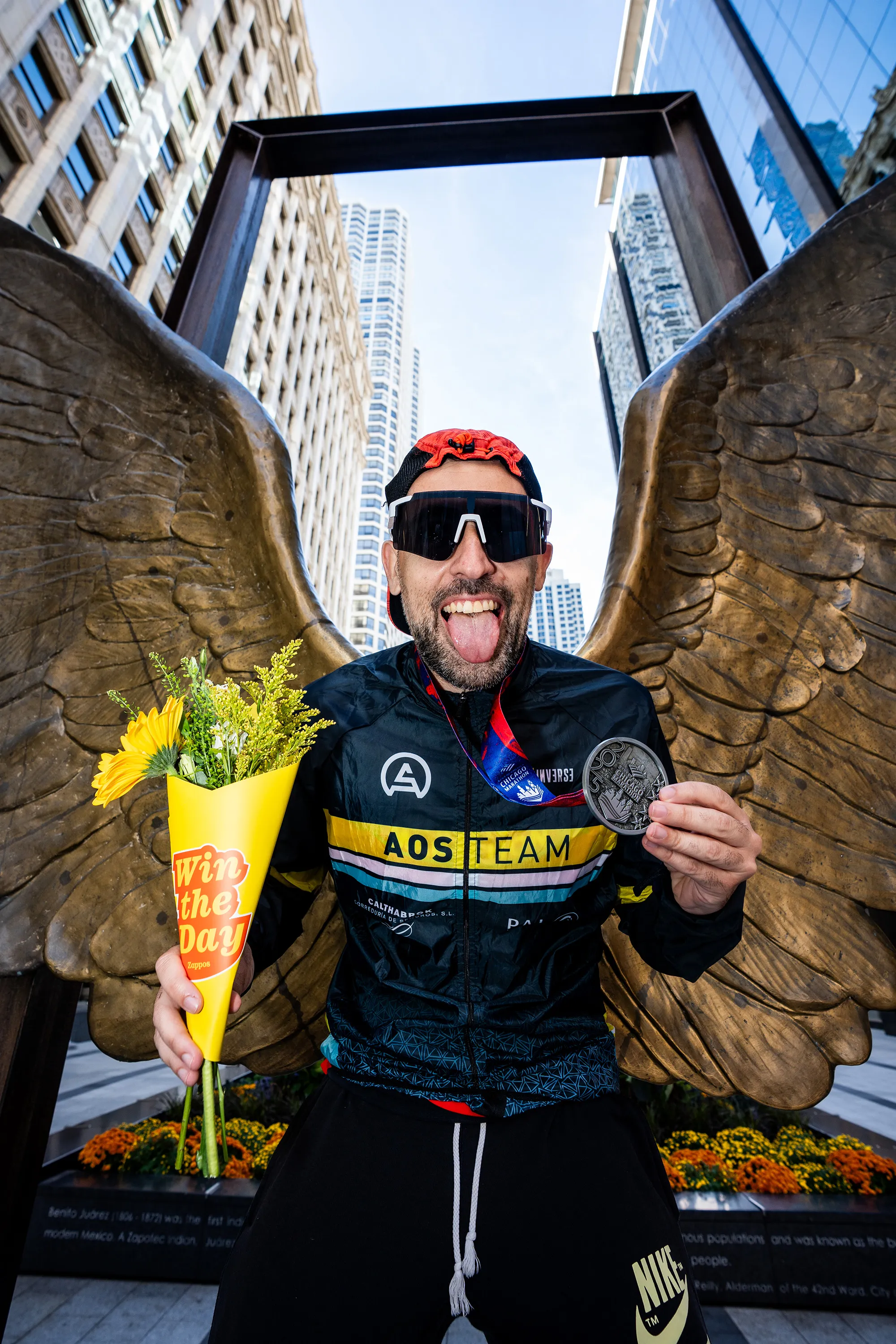
Zappos built Win the Day around the Chicago Marathon, gifting 1,500 bouquets to runners and drawing more than 60,000 visitors through the footprint. The campaign went from kickoff to live in twenty-five days, which is the detail most brands underestimate. Compressed timelines are normal in event-tied pop-ups because the date is fixed, and the build must be designed for that constraint from the first sketch.
Guerrilla Activations Built for Surprise, Oura Ring Guerrilla marketing trades budget for creative risk. It works on unexpectedness, which means it cannot be scaled by spending more, and it produces its return through the content that participants and passersby capture themselves. The best examples are usually the ones that were genuinely fun to walk past.
Oura Ring’s Give Us the Finger stunt ran in Manhattan and generated more than 40,000 organic impressions along with thousands of social likes and views. The economics are what make guerrilla worth understanding, even for brands with money to spend, because a campaign that costs a fraction of a tour can produce a real-world moment that people photograph without being asked.
Retail and Product Launches That Convert Strangers; OLIPOP’s The Pop Stop Product launches live or die on trial among people who have never bought the product. Total sample counts hide that, because a sample handed to an existing customer costs the same as one that wins a new buyer and returns far less.
OLIPOP’s The Pop Stop ran 48 activations across four markets over four months, covering more than 7,000 miles and distributing 128,658 cans. 35% of participants were new to OLIPOP. That percentage is rarer than any impression figure in this article, because it requires capturing prior purchase behavior at the point of sampling rather than counting units. It also converts directly into a cost per new customer, which is the number a CFO will ask for.
Sampling Measured on Conversion, Mush’s Breakfast Club Placing a sampling program where the target audience already is beats placing it where the most people are. The two are rarely in the same location, and choosing the second is the most common way to spend a sampling budget without converting anyone.
Mush ran its Breakfast Club across 133 boutique gyms and studios, distributing 56,658 products and hitting 96% of the program goal. 62% of sampled consumers were new to the brand. Achieving such a high rate depends almost entirely on venue selection, as a boutique fitness studio attracts the exact consumers a refrigerated oats brand wants while filtering out most people who would take a sample but never make a purchase.
Social Impact Activations, World Central Kitchen, and the NYC Vaccine Program Cause-driven activations build a different kind of connection, and they hold brands to a higher standard, because an audience that detects opportunism will punish it harder than it would punish an ordinary advertisement. Creating something a community genuinely needs is what leaves people connected to the brand afterward, and the work has to be substantive.
Promobile’s Feeding the Frontline program with World Central Kitchen served well over one million meals and employed 110 staff during a period when restaurant workers had lost their jobs. Separately, our mobile vaccine clinics for New York City ran 21 custom buses staffed by more than 360 medical personnel and reached 357,000 additional New Yorkers. Both used the same mobile infrastructure that carries sampling tours, which is the practical lesson underneath them.
Luxury Brand Worlds, Hermès in San Francisco Lifestyle brands and luxury experiential marketing make an abstract identity tangible for a few days. Success is usually not measured by volume, because the audience is deliberately small and the objective is depth of impression rather than breadth.
Hermès brought A Parisian Day to San Francisco , drawing more than 3,000 visitors and distributing over 5,000 magazine copies. The campaign’s real outcome was that it led to a larger American tour, which is the clearest verdict a client can deliver on an activation.
Technology-Led Activations, Gaming, and Augmented Reality Technology extends an activation past the people standing in front of it. Augmented reality marketing campaigns , virtual reality marketing experiences , and live gaming let a brand build a game world that anyone can enter, and the strongest programs connect that digital layer back to something physical.
Chipotle’s Ingredient Quest, which launched on Roblox in May 2025, offered the first 50,000 players who collected all 53 ingredient cards a free entrée, amounting to more than one million dollars in free food according to Chipotle’s own newsroom . The mechanic is worth studying because the virtual experience routed players to a physical purchase rather than ending inside the game.
Tech companies and consumer brands alike now treat digital elements as a layer on a live footprint rather than a replacement for one. AR lenses extend a physical activation into social feeds, while virtual experiences let people encounter products that are too large or too distant to bring to them. That layer earns its place at brand activations at festivals and other large events, where festival goers are already documenting the day, and a well-built digital element gives them something worth posting.
How To Build an Experiential Activation That Delivers The campaigns above look different from one another, but the process behind them does not vary much. Six stages separate an activation that produces a number from one that produces photographs, and most failures trace back to compressing or skipping one of them rather than to anything that happened on site.
Stage 1. Define the Number Before the Concept The single most consequential decision happens before any creative work begins, and it is choosing what the campaign will be judged on. A program built to maximize samples distributed will be routed toward dense, high-traffic locations. A program designed to maximize conversion among new customers will route to smaller venues that filter for the right consumer, distributing far fewer samples while returning more customers. Mush reached 62% new to the brand because that was the target from the outset. Choosing the metric afterward means the design was optimized for something else, and the reporting becomes an exercise in finding a flattering figure.
Stage 2. Match the Format to the Audience’s Geography Where the target audience is concentrated determines the format more than the creative idea does. An audience spread across the country needs a tour. An audience assembled at a known event needs a pop-up timed to it. An audience concentrated on campuses needs a campus program, and one clustered in a single city needs a fixed footprint that can run long enough to be discovered. Zappos worked because the Chicago Marathon assembled exactly the people the brand wanted. Lemon Perfect worked because no single event could have assembled its audience, so the tour went to them.
Stage 3. Design For the Senses and For Capture Once the format is fixed, the build has to do two jobs at once. It has to create a memorable experience through more than one sense, and it has to be photogenic enough that participants document it without prompting. These pull in different directions more often than people expect, because an environment that immerses someone fully can be difficult to photograph, and a set piece built purely for the camera tends to be shallow to stand inside. The resolution is usually a single strong visual anchor within a richer sensory environment, so there is one obvious shot and a great deal more to experience around it.
Stage 4. Resolve Logistics and Permits Early This is the stage that quietly kills campaigns. Vehicle permits, venue agreements, and health department clearances for anything involving food, power, water, parking, and insurance all run on external timelines that remain fixed regardless of schedule demands. Zappos went from kickoff to live in 25 days because the permitting path was identified in the first days rather than discovered in the third week. A tour crossing state lines adds vehicle compliance requirements on top, and the team checks those before finalizing routing rather than after.
Stage 5. Staff It With People Who Can Carry the Brand
The staff represents the brand during the interaction, and even the best build quality cannot compensate for a team that lacks product knowledge. Brand ambassadors need product training, not just shift instructions, because the interaction that converts a stranger is usually a question answered well rather than a sample handed over. On a program running 160 activation days, staffing consistency across markets becomes a genuine operational problem, and this is solved by establishing training standards and deploying a traveling core team rather than hiring locally at each stop and hoping for the best.
Stage 6. Capture the Data at the Point of Contact The figures that make a campaign defensible afterward can only be collected while it is running. Whether someone had bought the product before, what they thought of it, their email address, and which market performed best. None of it can be reconstructed later from a photograph. Building the capture mechanism into the interaction so it feels like part of the experience rather than a survey bolted onto the exit is what separates a campaign that reports 128,658 cans from one that reports 128,658 cans and 35% new to the brand. The second version is the one that gets the next budget approved.
“The brands that get the most out of experiential are the ones that decide what they are measuring before they decide what they are building,” says Jonathan Goldman. of Promobile Marketing. “If you know on day one that the number you care about is trial among people who have never bought you, that changes the venue, the staffing, and the questions your team asks at the table. Work it out afterward, and all you have is a headcount and some nice photographs.”
Ready to Build an Activation Worth Measuring? The activations that earn a place on a list like this are not the ones with the largest budgets. They are the ones that fixed their measure before the build, chose a format that matched where their audience already was, and captured the evidence while the campaign was still live. Every figure in this article exists because somebody made that decision at the start.
Promobile Marketing runs mobile tours, pop-ups, sampling programs, festival footprints, and social impact builds across the United States from its base at Dock 72 in Brooklyn. Our experiential marketing professionals have delivered well over two million samples on a single tour, reached 154 campuses in one program, and built the mobile infrastructure behind over a million meals served with World Central Kitchen. Contact us today to see what an activation could return for your brand.