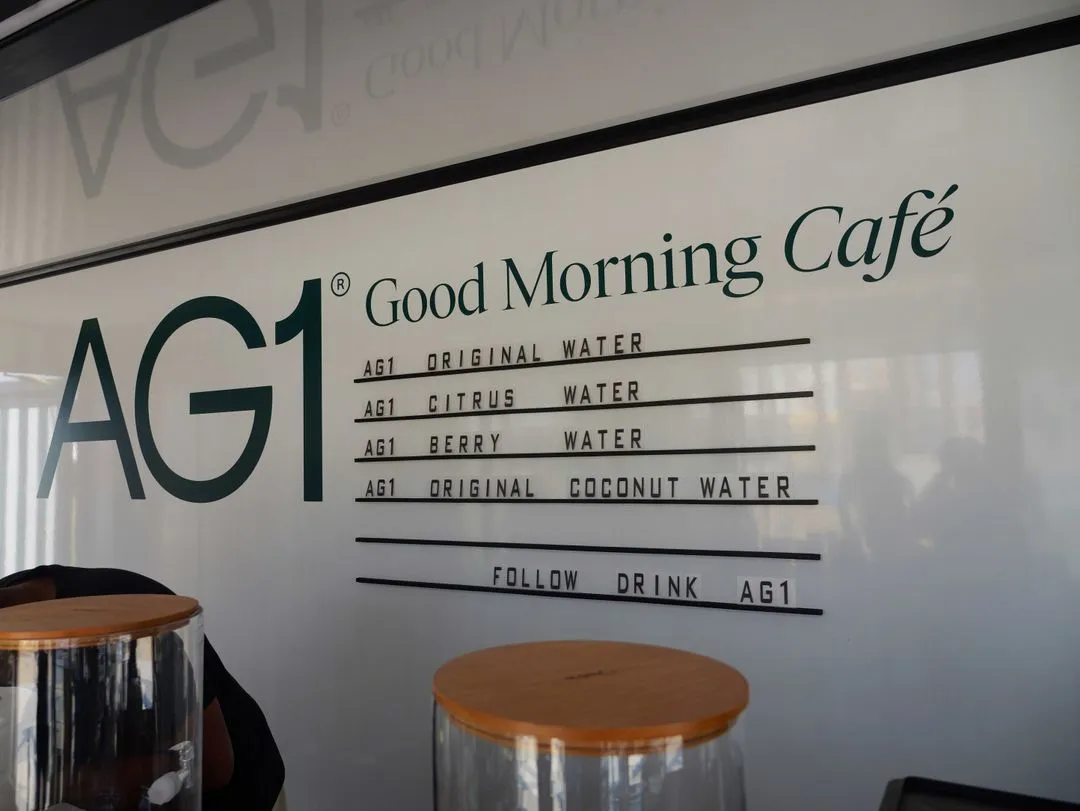
On the first of July 2026, a café opened on the Venice Beach boardwalk, served drinks made to order all morning, and then packed itself up and drove to another city. It was not a sampling table with a logo on it. It was a real café built around the rituals of a good morning, and it happened to belong to AG1.
Promobile Marketing built and ran the Good Morning Café in all four markets, alongside AG1's in-house creative team on experience design and tour logistics. It is the third campaign the two teams have delivered together, with fabrication, permitting, culinary, and staffing handled by our Brooklyn crews. Brands planning a mobile brand activation can request a quote , and we scope the build, the route, and the programming before anything gets fabricated.
This article covers what the Good Morning Café actually was, why the format worked, and what it says about the line between experiential sampling and experiential retail.
What the AG1 Good Morning Café Was AG1 sells a daily routine, and its brand experience had been transactional. The Good Morning Café was built to move AG1 from something people take to something people do, by turning the morning routine itself into a place you could walk into.
The result was a mobile café that opened in Venice Beach on July 1, 2026, then moved through Los Angeles, Culver City, Chicago, and Boston, with stops at wellness events including Faces of Fitness and Eudēmonia. For a wellness brand whose product lives in a daily habit, that route mattered as much as the build. Each city got the same café and a different set of neighbors, which is the hard part of any multi-city tour.
The Design Choices That Kept People in the Café The café and the sampling station serve two different jobs, which is what made the campaign behave differently from a standard product sampling run.
A sampling station is designed for volume. The transaction takes about eleven seconds; someone takes a cup and keeps walking, and every design decision serves that speed. The Good Morning Café was designed the other way round. Drinks were made to order rather than pre-poured, the seating was built to keep people in it, and guests read the Good Morning Gazette, a custom-branded newspaper carrying wellness content and morning inspiration, while they drank. Harmless Harvest Coconut Water came in as a feature partner, so the menu behaved like a menu rather than a single-product demo.
Dwell time is the mechanism by which a taste becomes a memory, and a memory becomes a purchase weeks later in a store aisle. A brand that gets those few seconds is buying awareness, and a brand that gets twenty minutes over a newspaper is buying a morning. The behavioral economics behind product sampling has pointed to that difference for years, and the café is what it looks like when a brand builds for it.
It Met People Where Their Mornings Already Happen The second decision that shaped the campaign was location strategy, and it ran opposite to chasing footfall. The tour parked in neighborhoods where wellness culture already existed rather than in the highest-traffic spots available. Venice Beach, then a run of locations chosen for who was already there at seven in the morning. Surfers, run clubs, yoga people, dog walkers, and meditators were the target audience, and they were already awake and out.
That choice meant AG1 never had to ask anyone to change their routine. The brand showed up inside a routine that was happening anyway, and a café that is open when you finish your run earns attention differently from a message about mornings.
Picking that kind of location takes more research than picking a busy corner. It means understanding a neighborhood’s rhythm and its hours rather than its traffic count, which is the same discipline behind choosing a pop-up location for any activation where the audience matters more than the volume.
How It Became a Community Hub What happened next is the part you can't buy, though you can design for it. Each stop was programmed with local run clubs, surf sessions, mobility classes, wellness partners, exclusive merchandise, and giveaways tailored to that city. The café was not just open. It had a schedule, and the schedule belonged to the neighborhood as much as to the brand, which is field marketing work rather than a media plan, because somebody has to know which run club actually meets on a Tuesday.
Once that was in place, creators, athletes, and local groups started gravitating to it on their own. Groups that already met in the morning started meeting there, and that is the point at which an activation stops being marketing and starts being infrastructure. Coming back is what turns consumer engagement into brand loyalty, and a written brand activation plan is where that intelligence gets turned into a schedule.
A Café That Packs Up in Minutes What made the tour possible was the build. The Good Morning Café uses a first-of-its-kind expandable format that deploys almost anywhere with minimal setup, then packs down in minutes and drives to the next city. That single capability is what let AG1 deliver identical premium hospitality in all four markets without rebuilding anything.
There is usually a trade-off here. A permanent-feeling space is slow and expensive to install, so it can only justify a handful of markets, while a fast mobile format deploys quickly and can read as temporary. The expandable design was built to refuse that trade, and custom fabrication is what made it possible, since nothing off the shelf opens into a full café and closes again before lunch.
That combination is what separates a genuine mobile marketing tour from a series of one-off builds. Every city gets the same layout, and the same hospitality standard, and the cost spreads across every market rather than being written off after one weekend, which is the economic case for multi-city roadshows .
The Morning It Broke Out On day one in Venice Beach, actress Malin Akerman stopped by the café during her morning. AG1 posted the moment across its social media channels, and press coverage followed from E! News, People, Us Weekly and DeuxMoi. All of it was earned media, not bought.
It would be easy to call that luck. Nobody booked the appearance. It happened because the café sat on the Venice boardwalk on a July morning, looking like somewhere worth stopping, in a neighborhood where people like her already spend their mornings, which is the argument for building something good enough to be walked into.
Experiential Sampling Compared With the Café Model The gap between a conventional sampling tour and what AG1 built is easiest to see side by side. The table below compares the two approaches across the decisions that actually shape the outcome.
Decision
Conventional sampling tour
The Good Morning Café model
Core goal
Maximum samples distributed per day
Maximum time spent with the brand per visitor
Space design
Built for throughput, people keep moving
Built for dwell, people sit down and stay
Product format
Pre-poured, identical, handed over fast
Crafted to order, with a partner product on the menu
Location logic
Highest available foot traffic
Where the target audience’s morning already happens
Programming
None, the product is the event
Run clubs, surf sessions, mobility classes, local partners
Repeat visits
Rare, the visit is a one-off
Designed for, the café becomes a regular stop
What the brand buys
An impression and a taste
A routine, a habit and a reason to come back
Neither column is wrong, and the choice follows the objective. A launch that needs a million trials in a quarter should run the left-hand column, and CPG sampling at that scale is its own discipline with its own hard problems. When a brand is trying to own a moment rather than a shelf, the right-hand column produces something a sampling tour is not built to produce. The same instinct drives the strongest creative pop-up marketing ideas , where the space is built to hold people rather than process them.
Why the Format Works The strategic insight underneath it all is simple enough to state in a sentence. The strongest experiential marketing does not interrupt people’s lives. It becomes part of them.
Most activations are built as an interruption. They appear in someone’s day, ask for attention, deliver a message and leave, which works and is measurable. The café fitted into a slot that already existed in people’s mornings and made that slot slightly better, so the product arrived through the experience rather than being announced by it. The same logic is reshaping immersive retail experiences more broadly, where the space is the message and what people do inside it is the campaign.
What It Takes to Run a Café on Tour A café that travels is easy to describe and demanding to run, and most of that work lives in the operational details. Serving drinks to the public means health department requirements that differ in every jurisdiction the tour enters. What is approved in Los Angeles County is not automatically approved in Cook County, and the paperwork does not travel with the vehicle. Each market has to be cleared in advance, which means the route is locked far earlier than a purely visual activation would require.
Staffing carries the same weight, and it is where multi-market tours are hardest to hold together. A café works when the person making the drink is good at making the drink and good at talking to the person waiting for it, so training a core team and moving it, then supplementing locally with people who have been properly onboarded, is what keeps the experience identical from Venice to Boston. Route planning has to satisfy the vehicle, the power supply, the permitting calendar and the community program at once, and getting those four to agree on an address is most of the planning work.
None of it appears in the finished experience, which is the point. A guest should encounter a café that feels like it has always been there, order a drink, read the paper, and leave.
The Team Behind It AG1’s in-house creative team owned the vision. Promobile Marketing worked alongside them on experience design and tour logistics, then built and ran the café in every market.
Over the last few years, Promobile has become the experiential agency behind national campaigns for some of the biggest names in food, beauty and tech. The Liquid I.V. hydration fleet, the NYC.gov mobile vaccine program, and pandemic work with World Central Kitchen came out of the same building.
“A sampling tour asks for eleven seconds, and a café asks you to sit down,” says Dominick Tomanelli, CEO and Co-Founder of Promobile Marketing. “Everything hard about this build came from that one decision. Getting a real café to open, serve, and disappear in a morning, in four cities, is a logistics problem disguised as a design problem.”
Brands weighing whether to run this internally or bring in a partner usually find the answer in the logistics rather than the concept, which is the honest case for hiring an experiential marketing agency . The rest of the work sits in the activation portfolio , alongside social impact activations built on the same operational spine.
Ready To Build Something People Come Back To? The Good Morning Café worked because it chose dwell over throughput, neighborhoods over footfall, and a build that felt permanent while packing down in minutes. Those choices are what turned a supplement into a morning ritual with an address. The format is repeatable for any brand whose product lives inside a habit.
Promobile Marketing designs, fabricates, and operates branded pop-ups and traveling brand experiences with in-house teams working out of Brooklyn, and has delivered three campaigns for AG1 alone. Our experiential marketing team handles design, fabrication, permitting, culinary, staffing, and route planning under one roof, which is what makes an identical experience in four cities possible. Contact Us Today and tell us what your version of this looks like.