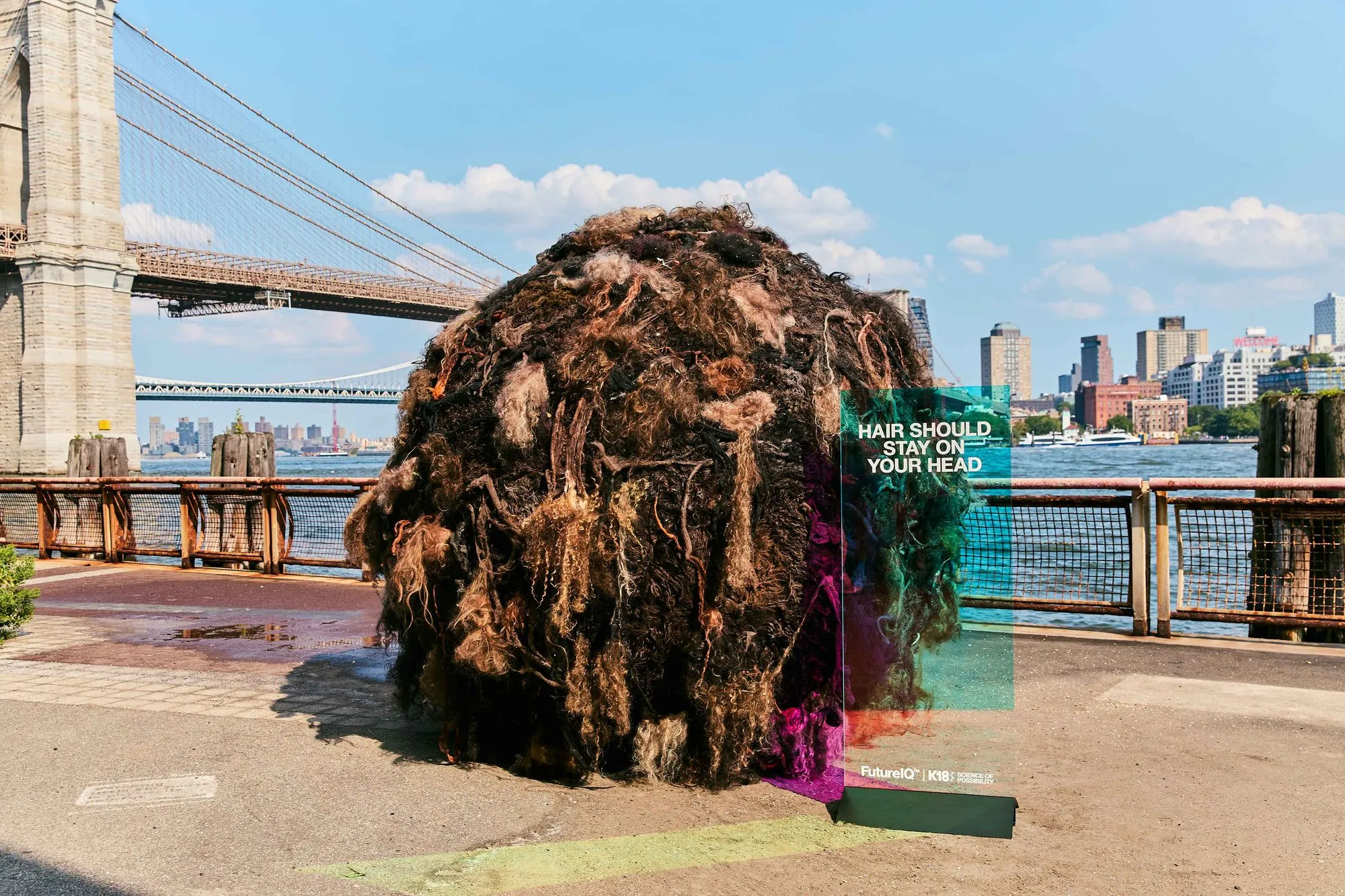
In August 2026, an eight-foot ball of real human hair and wigs rolled through high-traffic areas of Manhattan before coming to rest outside Sephora in the Meatpacking District. Millions of people who saw footage of K18’s Tumblehair assumed it had to be AI. It was not AI; it weighed around 150 pounds, it was sewn by hand, and it became the most talked-about experiential marketing stunt of the summer.
Promobile Marketing fabricated the functional prop and ran the production, handling the engineering, execution, and permitting alongside Uncommon Creative Studio, the creative agency that devised and led the idea. Our teams have spent over a decade putting physical objects into American cities legally and on schedule, from the Chicago Marathon finish-line build for Zappos that drew 60,000 visitors to a Super Bowl week lounge for Tums. Our branded pop-ups and installations run on budgets from $50,000 to $5 million. If you have an idea that sounds impossible to put on a public street, contact us to tell us what you are planning, and we can tell you what it will take to make it real.
This article covers how the Tumblehair came together, why the internet was so sure it was fake, and what the whole thing reveals about physical marketing at a moment when audiences assume everything is generated.
What the Tumblehair Actually Was The Tumblehair was a rolling installation built for K18, the biotech haircare brand, as the centerpiece of a product launch for its FutureIQ biomimetic hair longevity serum. As a beauty brand entering a crowded category, K18 needed a new product to arrive with more than a campaign page behind it. The brief was a launch campaign that would build brand awareness among a target audience who had never knowingly thought about hair longevity. It measured roughly 10 feet in diameter and weighed about 150 pounds, likely more once it was finished.
The material was the part people struggled with. It was made of real human hair blended with synthetic hair, sourced from across New York City, including from K18 partner stylists’ salons. That sourcing decision was deliberate rather than convenient. The build went through many rounds of research and development so the finished ball represented every color and texture of New Yorkers’ hair, and so it would hold together well enough to roll.
The number behind it was the campaign’s argument. The ball was scaled to represent 161 billion strands, which is what New Yorkers could collectively retain each year using the serum, calculated from the city’s 8.5 million residents multiplied by the hairs the product is claimed to save per person. K18 cites clinical data showing users retained up to 19,000 more hairs after 90 days.
Hair loss is not a niche concern, which is what made the scale defensible. Roughly 40% of men show visible thinning by 35, rising to between 50 and 65% by 60. Around 40% of women notice thinning by 40, and more than half do after menopause, according to research from the National Council on Aging that K18 cited alongside the campaign. Uncommon’s creative directors, Lauren Cooper and Cara Johnson, framed the object as taking something 80 million Americans deal with and making it impossible to ignore.
Why Everyone Was Certain It Was AI
Here is the part worth pausing on, because it is genuinely new.
For most of the last decade, the risk with a publicity stunt was that people would believe it. Viral marketing depended on it. Now the risk runs the other way. Audiences have been trained by a flood of generated video to treat anything unusual as fake by default, and the first instinct on seeing something impossible is no longer wonder but suspicion.
The Tumblehair walked straight into that. Footage spread over a weekend, and the reaction was near-unanimous disbelief. The press coverage that followed was shaped entirely by that doubt, and most of the media coverage led with the question of whether the thing was even real. NewBeauty published under the headline “No, That Giant Hairball You Saw Rolling Through the Streets of New York Over the Weekend Wasn’t AI,” opening with the observation that social media users who spotted the footage were quick to assume it was AI-generated before confirming it was a real, physical prop.
That inversion did more work than any media buy could have, and it produced more user-generated content than a paid brief would have bought. The usual pattern is that a spectacular thing turns out to be generated and the audience feels cheated. This one ran backwards. People assumed it was generated, went looking to debunk it, and found a physical object they could walk up to and touch. The debunking became the distribution. Authenticity stopped being a brand value and became a media mechanic, because the only way to settle the argument was to go and look.
Muse by Clios put it plainly, describing the campaign as a truly special tactile effort in a world of non-stop digital polish. Being real was the media strategy. Every person who tried to prove the footage was AI-generated ended up carrying the campaign further, and the social sharing that followed was free earned media rather than paid impressions.
Guerrilla marketing has always traded on surprise, and street marketing of this kind has always relied on being physically present where people are. What changed is that out-of-home advertising now carries a credibility premium it did not have five years ago. There is a lesson in that for anyone planning creative pop-up marketing ideas right now. Physical execution used to be the expensive way to achieve something a render could fake. It has quietly become the only way to earn a reaction that a render cannot.
The Creative Behind It The idea came from K18 and Uncommon Creative Studio, the agency partner who devised the campaign and owned the creative throughout. An experiential agency then has to work out whether the idea can survive contact with a real city. Their starting point was a communications problem rather than a visual one, since hair shedding is close to universal and rarely discussed openly.
Cooper and Johnson described the intent as refusing to talk about hair loss the way the industry always has, quietly and apologetically. The Tumblehair was built to say the quiet part out loud. It is an absurd object, and the absurdity was the point, because a tasteful execution of this message would have been scrolled past.
Turning that thought into something that could legally occupy a New York street is where our work started.
Building a Functional Prop That Could Survive the Street Promobile Marketing fabricated the Tumblehair. Not the concept and not the surface treatment, but the functional prop itself, the thing that had to hold 150 pounds of hair together and roll across New York City for four neighborhoods without coming apart. Prop stylists at CAD Industries and Decimated Designs hand-styled and sewed the hair that covered it, and both houses normally build for horror and science fiction activations, which was the right instinct for the look. What sat underneath, and what made the object work as an object, came out of our shop.
That distinction matters because the hard part of this build was never the appearance. Custom fabrication at this scale is closer to practical effects engineering than to signage, and the Tumblehair had two requirements that actively fought each other. It had to read as a genuine accumulation of human hair, loose and organic in every shade and texture found in the city. It also had to survive being pushed for miles across asphalt, curbs, park paths, and alleys; absorb repeated impact, keep its shape under its own weight, and stay safe with crowds pressing in on it.
Those two demands pull in opposite directions. Anything built to look convincingly loose wants to shed and deform, and anything built to survive a city wants to be rigid and sealed. Reconciling them took repeated rounds of research and development before a single strand went on. That engineering is what carried the Tumblehair through the entire route in one piece.
Movement was the next question to solve. The team worked through every option, including a remote controlled car mounted inside the ball, testing each against how it behaved on a real street. The simplest answer turned out to be the right one, which was five of the strongest crew members pushing, steering and rolling it by hand. On an object this size, a human crew reads a curb or a pedestrian sooner than any mechanism can.
Getting a Giant Hairball Legally Onto New York Streets This is the part the coverage described without naming anyone, and it is the part that decides whether a campaign like this happens at all. It is also the reason a production partner earns their place on a project like this.
Rolling an object through Manhattan is not a matter of showing up and starting to push. As the campaign’s creators told Muse by Clios , it takes a deep crew of on-the-ground production experts. It requires location permitting across multiple neighborhoods, direct communication with the Mayor’s office, route planning that accounts for traffic and pedestrian density at specific hours, and coordination with local police in each precinct the route touches. Every one of those has its own timeline, and they do not run in parallel as neatly as a production schedule suggests. Occupying public space in Manhattan is a negotiation with several authorities at once, and the same discipline governs choosing a pop-up location on a smaller build.
Route planning on a project like this is not a map exercise. The route has to work for the object, so it needs surfaces the ball can actually cross, turns it can actually make, and stretches where a 150-pound sphere and five crew members will not create a genuine hazard. It also has to work for the camera, since a stunt that nobody films is just an expensive afternoon. Those two requirements frequently disagree, and reconciling them is most of the job. Route planning across multiple neighborhoods is the same skill that runs a multi-city roadshow , compressed into a single afternoon.
Releases are the other piece, and they rarely come up outside production. A dedicated team of production assistants secured a signed release from everyone who appeared on camera. On a moving route through a crowded city, beside an object built to make people stop and film, that is steady work for the length of every shooting day.
“We built the part that had to work under load,” says Dominick Tomanelli, CEO and Co-Founder of Promobile Marketing. “Holding 150 pounds together, rolling it across four neighborhoods and keeping it safe in a crowd is an engineering problem. Solving that is what let the idea exist out in the world.”
This work sits behind the scenes, and it holds everything else up. It is the same discipline behind permits and legal requirements for a pop-up , scaled to an object moving across a city. Handled early, it is what gives an ambitious idea somewhere to actually happen.
Where It Landed The route carried the Tumblehair through Midtown, the West Village, Chinatown, and the Seaport before its final public appearance on Wednesday, August 12, 2026, at Gansevoort Plaza outside Sephora Meatpacking.
That landing point was doing deliberate work, and it functioned as a branded pop-up in everything but name. A rolling object generates attention but cannot convert it, so the campaign needed somewhere for the attention to go. At Gansevoort, K18 ran a Hair Longevity Lab from 11 am to 7 pm, where visitors received complimentary scalp analyses, spoke with the brand’s education team for personal product recommendations, and handled the product directly. There was a claw machine stocked with K18 prizes, and anyone buying the FutureIQ serum received a scalp gua sha engraved on-site. Consumer engagement of that depth is what separates an activation from an advert, and it follows the same logic as CPG sampling , where trial is the whole point.
People could also photograph the tumblehair up close and touch it, which mattered more than it sounds. Touching it was the proof, and the photo ops it created carried further than the foot traffic on the day. Patch described it as K18’s largest public activation to date.
The structure is worth copying, and it applies to event marketing of almost any scale. The spectacle travels and creates the question, and a fixed destination answers it in person and captures the demand. Running the roll without the landing would have generated a great deal of attention with nowhere to spend it.
What It Takes To Put an Object Like This on the Street Most of the work on a stunt of this kind is invisible in the final footage, which is why budgets for it are so often underestimated. The table below sets out the workstreams behind an object like the Tumblehair and what happens when each one is underfunded.
Workstream What it actually involves What happens if it is underdone
Fabrication research and development Repeated prototyping to reconcile how an object looks with whether it can survive being moved The object fails on day one, in public, with the press watching Permitting and city coordination Location permits by neighborhood, mayor's office communication, precinct-level police coordination Dates move, or the activation is stopped mid-route Route planning Surfaces, turns, gradients, hazards, and pedestrian density are matched against where the shot works The object cannot physically complete the route it was booked for On-street crew Trained people moving, steering, and protecting the object continuously Safety incidents, damage, and a crowd nobody is managing Releases and clearances Production assistants securing signatures from everyone captured on camera Footage that cannot legally be used, which removes most of the campaign value Landing destination A fixed location where attention converts into trial, data, and sales Enormous reach with no mechanism to capture any of it
Every line in that table is a place where an ambitious idea quietly becomes an impossible one, and a written brand activation plan is where each of them gets an owner and a date. Handling them is why brands end up hiring an experiential marketing agency rather than running a build like this internally.
What the Tumblehair Says About Marketing Right Now The strategic takeaway is not that weird, though it does. It is that the value of physical execution has changed.
When anything can be generated convincingly, a rendered spectacle costs almost nothing and earns almost nothing. The scarce thing is the object that survives inspection. An audience that has learned to assume fakery will interrogate what it sees, and the campaigns that reward that interrogation get a second wave of attention that the original impression never bought.
That reverses a decade of received wisdom about how a marketing budget should be split. Brand recall from a real brand experience someone stood next to behaves differently from recall bought through impressions. Fabrication, permitting, and street-level execution used to be the costly path to an effect you could approximate digitally for less. They are now the only route to a reaction that cannot be approximated at all, which makes them a media investment rather than a production line item.
It also rewards specificity, which is where brand storytelling stops being a phrase and starts being a material decision. The Tumblehair worked because it was made of the actual material it was about, sourced from the actual city it rolled through. A generic giant ball would have been ignored, and a rendered one would have been dismissed. Brands planning mobile brand activations should take the harder version of the idea seriously, because the difficulty is increasingly the message. The same shift is reshaping immersive retail experiences , where being physically present is the differentiator rather than the overhead.
Need an Experienced Experiential Marketing Team? The Tumblehair worked because an unreasonable idea was matched with the fabrication and production discipline to build it, then put it on a public street legally, safely and on the day it was promised. Ideas of this ambition fail far more often in permitting and logistics than in concept. Getting the execution right is what separates a campaign that runs from one that stays in a deck.
Promobile Marketing has spent over a decade building and running physical activations for brands from startups to national names, with design, fabrication, permitting, culinary and staffing handled by in-house teams out of our Brooklyn headquarters. Our experiential production team works on campaign budgets from $50,000 to $5 million, and the rest of the work is in our activation portfolio . Contact us with the idea you have been told cannot be done.