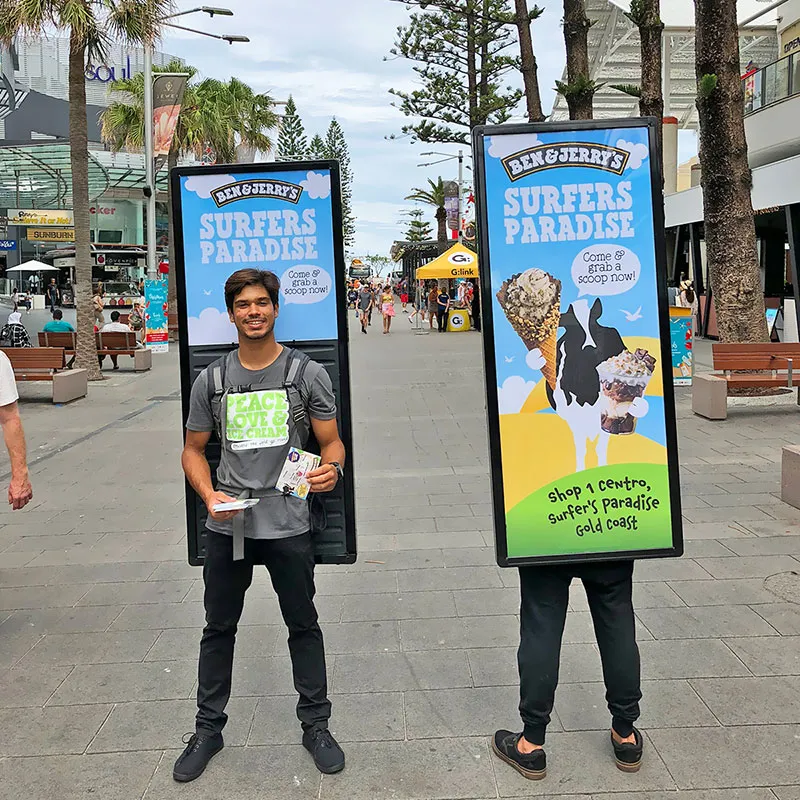
Street team marketing puts trained brand ambassadors in high-traffic public spaces, where they hand your product to real people and talk to them face-to-face. It’s a form of guerrilla marketing built on samples, product demos, and real conversations at street level. Done well, a street team marketing campaign turns a sidewalk into a sampling floor and a stranger into a customer.
Promobile Marketing has spent over a decade putting street teams on the ground in New York and every other market that matters. Our mobile brand activations pair a street team with a vehicle and a permit that holds up, so your brand message lands on the right block at the right hour. If you’ve got a launch or a market test that needs people on the sidewalk, contact our team , and we’ll build the plan around your goal.
This article covers what street team marketing is, where it came from, why it earns a line in your marketing plan, what a campaign costs, the permits it needs, how to staff, site and measure it, and how it compares with the channels chasing the same budget.
What Is Street Team Marketing? Street team marketing is a promotional tactic where a company hires a group of brand ambassadors, often called street team members, to promote a product directly to consumers in public. The team works a high-traffic area on foot and hands out sample products and promotional materials.
The tactic came out of music. In the 1980s, independent record labels and bands with no ad budget recruited fans to plaster flyers and hand cassettes outside record stores, and the band KISS ran one of the earliest fan armies.
What does a street team activation look like on the day? The team hands out product samples, runs demos, collects surveys, distributes flyers and branded T-shirts, and pushes people toward a sign-up. The venues vary. Street corners outside transit hubs, college campuses, music festivals, and pop-ups all get the same playbook.
Street marketing is guerrilla marketing on foot. It belongs to the same grassroots marketing family as street art and flash mobs. Run a street team alongside a guerrilla marketing stunt, and the wheatpaste pulls the eyes while the ambassadors do the talking. An experiential marketing agency treats a street team as the cheapest instrument in that kit.
What Do Street Teams Do? You've almost certainly encountered street teams before; they are the men and women handing out samples or information in public spaces or at events. Street teams use the power of friendly, engaging face-to-face interaction to get people interested in your brand, and they get there through a wide range of activities.
A street team activation typically involves handing out flyers, branded merchandise, t-shirts, and free product samples. Often, they'll accompany a food truck, bus, or other high-visibility vehicle to engage audiences and draw them in. They may also give live product demos, pose for photos, conduct surveys, and answer audience members' questions. Performers, such as dancers or musicians, are sometimes part of a street team, and interactive kiosks might also be incorporated.
Whatever their specific activities, street team marketing campaigns not only invite consumers to sample products, but they also inspire word-of-mouth and social media sharing and build brand awareness among a target audience.
How Does Street Team Marketing Relate to Guerrilla Marketing? Street team marketing is a form of guerrilla marketing . The key difference is that street teams create direct, human-to-human interactions between brand representatives and your future customers. Other forms of guerrilla marketing, such as flash mobs or street art, rely on the element of surprise to capture consumers' attention, and often there is little to no direct interaction between the team and the audience. A street team creates opportunities for consumers to connect with your brand in a way that's more personal, memorable, and informative than many other forms of guerrilla marketing.
Why Add a Street Team Marketing Campaign to Your Marketing Plan? A Street team offers several advantages for your business, whether used alone or in concert with other guerrilla marketing techniques, as these case studies demonstrate.
High Visibility Minus Coffee approached Promobile Marketing for help launching their bean-free, environmentally conscious coffee. Promobile Marketing created a food truck campaign and organized a street team to bring free samples to the public in a fun, engaging way. The truck secured a spot in a high-visibility, high-traffic area to bring awareness to their no-bean coffee. Free samples, marketing materials, and face-to-face experiences heightened brand awareness and helped the brand connect with its audience.
More than 6,800 samples and 700+ consumer surveys later, Minus Coffee scored more than 400 direct online sales and learned a lot about their target audience, information it can use to develop future marketing campaigns.
Short Feedback Loop Street team staff can drive sales and increase a brand's recognition, but there's another, perhaps greater benefit: the instant feedback of having a face-to-face, real-time presence as your potential new fan base encounters your product for the first time.
One example: Meati, a plant-based meat company, worked with Promobile Marketing to conduct blind taste tests , gathering hundreds of consumer opinions about the product at significantly lower cost than traditional focus groups. Data gathered from this “mobile focus group” approach influenced Meati's product development decisions and built trust between the brand and consumers.
Targeted Engagement Street teams can be used to target highly specific audiences by meeting consumers where they are. In one example, personal care brand Dove marketed its deodorant to Gen Z women with a campaign that promoted a message of confidence: #bigpitenergy. To make it happen, Promobile Marketing secured space at major music venues on three coasts — East, West, and Gulf — for product and swag giveaways. By creating a presence at music festivals, the campaign was able to put 160,000+ samples in the hands (and pits!) of exactly the audience Dove wanted to reach .
Product Education Some brands' products sell themselves, and others need help clearing up misconceptions and getting consumers to give them a try. For products that are difficult to understand, the firsthand experiences street teams create can dispel consumer doubts and win over fans.
Here's one example: Promobile Marketing worked with Miyoko's Creamery to bring plant-based dairy products like milk, cheese, and butter to large numbers of potential customers. Food trucks handed out samples of menu items made with Miyoko's products at high-volume, food-oriented events such as food and wine festivals. Nearly 50,000 samples were served to people in California, Arizona, and Texas at 34 retail locations and 20 events, educating tens of thousands of potential customers about the products and brand.
Another example: Established in 1843, The Economist magazine has a solid reputation as an independent global media outlet. But times change, and the magazine wanted to attract a new generation of readers. The Economist hired Promobile Marketing to create a fun, unexpected experience that would change young consumers' minds about the brand and increase subscriptions.
In partnership with several food brands, Promobile organized a food truck and hired a street team to target people in high-traffic locations with free food and information about the magazine's Feeding the Future and Grounds for Change campaigns. The goal: to educate the public on food waste and highlight the alternative protein market while raising The Economist's profile among young consumers.
Their efforts paid off: the magazine scored over 130,000 new subscribers in 14 countries and generated $1.7 million in revenue, a 171% ROI.
Word Of Mouth You Can Actually Trace Street teams build buzz that outlives the day. Event Marketer reported in the same EventTrack 2026 study that 82% of attendees told friends and family about their engagement with the brand, and that conversation reaches people who were never on your route.
Real-World Attention Is Getting Scarce The Bureau of Labor Statistics American Time Use Survey for 2025 found Americans spent 37 minutes a day on games and computer leisure against 35 minutes socializing, down from 41 minutes in 2015. Eventbrite research across 4,051 people aged 18 to 35 found 74% think in-person experiences matter more than digital ones.
What It Costs Against Digital Ads Six ambassadors on a corner for eight hours is about $1,040 in wages at the Bureau of Labor Statistics median for the New York metro, and the city publishes the permit fee for that same block on that same day. Both numbers sit on public pages you can open before an agency quotes you. A paid social buy prices itself in the auction, after you have committed the money.
How Much Does a Street Team Marketing Campaign Cost? Most agencies won’t put a number anywhere near this question. Here’s what’s knowable.
The biggest line is people. The Bureau of Labor Statistics puts the median wage for demonstrators and product promoters at $18.91 an hour nationally and $21.62 across the New York, Newark, and Jersey City metro.
Then the city takes its cut. A promotional activation in a curb lane or on a sidewalk is a small street event at $3,100 per location per day on the Street Activity Permit Office fee schedule. Put up a tent, and you’re in the medium tier at $11,000. Three corners over three days prices as nine permit fees.
Marketing materials, storage, a vehicle, and agency hours stack on top.
Permits, Permission, and Public Space Permitting is the part of a street team plan the city controls. New York publishes a price and a filing deadline for every tier.
City Permits and Lead Times Start with the free door. The Mayor’s Office of Media and Entertainment states you don’t need a film permit for a handheld camera or a tripod, as long as you aren’t claiming exclusive use of city property.
The paid door runs on a calendar. The Street Activity Permit Office takes applications for small street events 14 days out, medium 30 days, and large 45 days, and every tier needs at least $1,000,000 in liability insurance naming the City of New York.
Permission From Property Owners Your permit covers the sidewalk. The doorway behind it belongs to a landlord with their own paperwork.
Pedestrian plazas sit with a business improvement district that runs its own application, and privately owned public spaces belong to a landlord who wants insurance and weeks of lead time.
The real money risk lives here, and the party that pays is often the agency or the property owner. When San Francisco fined an unpermitted brand sign $4,447, the San Francisco Chronicle reported the landlord paid it. Ask whether your marketing agency carries the million-dollar policy the city already demands.
Keeping the Sidewalk Clear An officer stops at your table mid-morning. Your queue has swallowed the footpath.
New York defines a small street event as one with low impact on pedestrian traffic, and crossing that line puts you in a conversation with an officer who can end your day at eleven. A table and a queue take up more sidewalk than you think, so leave a clear path along the building line and never block a curb ramp, a subway stair, a hydrant, or a store entrance.
Staffing a Street Team That Actually Shows Up Casting takes an afternoon. Getting six people to the corner on a wet Tuesday takes a bench.
The Bureau of Labor Statistics counts roughly 3,800 demonstrators and product promoters across the entire New York and New Jersey metro, compared with 64,520 nationally, and the same agency’s employment projections put the occupation flat through 2035, with 11,400 openings a year and roughly 18% turnover. The good street team members are already booked.
Securing reliable staffing is a challenging task. Ensure you have backup team members ready for every shift.
Gio Martinez, co-founder and CSO of Promobile Marketing, says, “The brands that get the most out of a street team are the ones who let us hire for temperament and then trust the crew to talk like people. You can teach anybody the product in twenty minutes. What you cannot teach in twenty minutes is staying warm to a stranger at four in the afternoon on a cold corner, and that is the whole job.”
Training is the final step. Provide a brief overview for the first seven seconds, including a key message and a clear request, then allow them to engage in natural conversation. Genuine discussions drive product sales.
Choosing Locations and Building a Route Foot traffic is wildly uneven, and the gap between corners on the same avenue is wide. The same MIT model puts Midtown Manhattan at about 1,700 pedestrians per sidewalk segment per hour and Brooklyn Heights at 277. Our own teams find the quieter corners buy longer conversations.
Give each rep a tight territory, one street corner and the approach to it, then rotate every twenty to forty minutes. The same corner converts differently at 8 am and 4 pm. A transit hub at rush hour hands you a commuter with a train to catch, so the ask is a sample and a card.
A campus gives you a dense target audience you can hit across a semester, and a college marketing agency already knows which quads need a permission slip.
How To Measure a Street Team Marketing Campaign What are the four numbers you want out of the day? Decide before the team leaves the warehouse.
Interactions per hour per rep tell you how hard the team is working to engage customers, and conversion to the next step tells you whether the talk track works. Break both out by location and time block.
Capture mechanics make that defensible. Trackable links and QR codes on the sample sleeve, a coupon code against a POS system, and sign-ups landing in your CRM with the corner attached. Product sampling programs are pushing tens of thousands of units live or die on whether anybody counted the redemptions.
Impressions are an uncalibrated metric. In Adweek ’s 2025 Experiential Awards, Taco Bell’s entry reported 3,000 participants and 18.4 billion earned impressions, while Event Marketer put the Grand Ex Campaign of the Year, Visa’s concert at the Louvre, at 9.3 million social impressions and 4,600 fans on site. Both were submitted in good faith, and they sit three orders of magnitude apart. So ask for counted things. The EventTrack 2026 study found 51% of consumer marketers now name leads and data collection their most important event metric, a first.
Street Team Marketing Against the Other Options Five channels compete for the same budget line, and each one buys a different thing. The table below sets street team marketing beside the four marketing campaigns most brand-side buyers weigh at the same money, weak spots included.
Channel
What It Buys You
Where It Falls Short
Best Used When
Street team marketing
Face-to-face trial, real conversations and first-party data inside a defined geography
Slow to scale nationally, weather dependent, capped by how many people walk past
You need a trial in real life or proof in one metro before a wider rollout.
Paid social
Fast reach and granular targeting you can optimize inside a week
No physical trial, rising costs, attention measured in fractions of a second
You need volume or a launch amplified well beyond the block.
Out of home
Broad repeated exposure that helps build brand awareness across a market
One-way exposure that is hard to attribute, and nobody tastes a billboard
You want a city to recognize the pack before your team hits the street.
Influencer
Borrowed trust plus content you can reuse everywhere else
The audience belongs to somebody else, cost per result swings, and reputational risk you do not control
Your product photographs well and needs credibility from a person the audience already follows.
In-store retail sampling
Trial inches from the shelf and clean conversion to purchase
Retailer gatekeeping, fees, a fixed footprint, and it only reaches shoppers already in the store
You are defending distribution or driving velocity in accounts you already have.
The strongest strategy runs two of these together. Your street team creates the moment on the ground, and digital ads get cheaper once a few thousand potential customers have met you.
How To Run a Street Team Marketing Campaign Most campaigns that go sideways didn’t go sideways on the day. They went sideways six weeks earlier, when somebody picked four goals instead of one or left the permit application until the markets were already booked. The sequence below is the one our teams run, and the order matters as much as the steps do. Work it front to back, and every later decision gets easier, because the goal tells you the market, the market tells you the corner, and the corner tells you what paperwork you need.
Step 1. Set One Measurable Goal Pick one. Trial, sign-ups, coupon redemptions, or a local sales lift, and write the target number down before anything else moves. A campaign chasing four goals returns four mediocre reports.
Step 2. Pick the Markets and the Corners Choose two or three metros you can genuinely service, then get specific down to the intersection. Pull pedestrian counts and walk the block at the hour you’ll work it.
Step 3. Clear the Permits and the Permissions Start this the day your markets lock. Public space needs a city permit, private property needs a written yes from the owner, and both take longer than anyone plans for.
Step 4. Cast and Brief the Team Hire for temperament first. The street team members who work out can open a conversation with a stranger and still be warm in hour four. Overstaff with a bench of one or two per market.
Step 5. Build the Kit and the Talk Track The kit is whatever one rep can carry and set up alone. Sample products, promotional materials, a branded tote, QR cards, and a charged phone. Your brand message has to survive a windy corner, so rehearse it.
Step 6. Run the Day and Report It Open with a fifteen-minute huddle so everyone knows the goal and the geography. Have leads log counts hourly so you can move people to the corner that’s working. Get the recap out the next morning.
Street Team Marketing Campaigns That Delivered A successful street team campaign leaves numbers behind. Here are recent street team and product sampling programs with published results.
PHX Hydration Energy PHX Hydration Energy had a crowded retail debut to support. Promobile ran branded Rivians and local street teams across four metros and sampled 51,329 cans over 33 live days.
MUSH MUSH wanted a trial in three dense metros, so the plan mixed guerrilla street sampling with drops at 133 boutique gyms. It distributed 56,658 products, and 62% of the consumers sampled were new to MUSH.
The Economist The Economist had the harder job, because a magazine has to make you care before it can sell you anything. Three branded food trucks served alternative proteins for its Feeding the Future initiative and got strangers arguing about food waste, and Promobile’s results are 130k new subscribers and a 60% retention rate.
RXBar RXBar sent a single “B.S. Blocker” truck into New York City in January 2025, rigged with panels that blocked billboards two stories up. Marketing Dive reported Instagram engagement up 504% from one truck in one city, alongside a claimed 2.8 million out-of-home impressions.
Ready to Put a Street Team on the Street? A street team gets your product into real hands in a high-traffic area and tells you what potential customers thought before you’ve spent a quarter of your media budget finding out. You get a trial, sign-ups, word of mouth you can trace, and a route you can adjust the same afternoon. Execute effectively; a single program can fulfill both a sampling budget and an awareness budget simultaneously.
Promobile has spent over a decade building street team marketing campaigns for brands like Liquid I.V., OLIPOP, Yerba Madre, and The Economist. Our experiential marketing professionals handle permitting, staffing, kit, and real-time reporting so your team can watch the numbers land. Contact us today to scope your markets, your street corners, and your numbers.